Set of 2 Chopping Boards in Acacia Wood with Handle
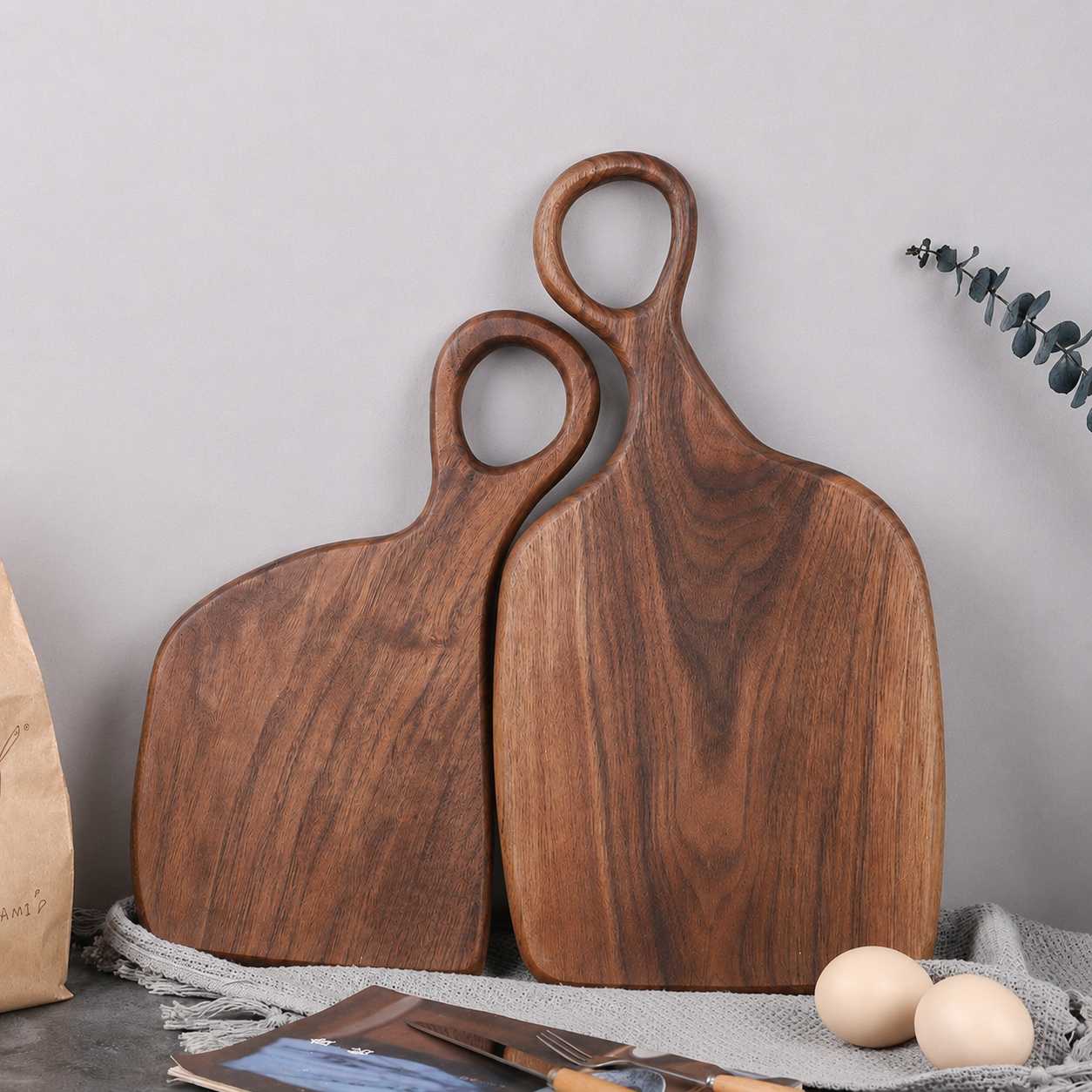
This set of 2 chopping boards in acacia wood provides you with two practical sizes for preparing and serving various food items. The boards can be used for cutting bread, cheese, fruit, vegetables, and other ingredients or as serving boards for snacks and smaller dishes.
Both chopping boards feature an integrated handle with a large opening, making them easy to lift, move, and hang up. The different sizes allow you to choose the board that best suits the current task.
Key Benefits
- Set of two chopping boards in different sizes.
- Made from acacia wood with natural grain patterns.
- Integrated handles make the boards easy to lift and move.
- Can be hung up through the opening in the handle.
- Suitable for preparing bread, cheese, fruit, and vegetables.
- Can also be used as serving boards for snacks and smaller dishes.
- The smooth cutting surface provides a stable workspace.
- Two sizes make the set useful for both smaller and larger tasks.
- The boards are approximately 1 cm thick.
Overview
This chopping board set with handle consists of a smaller and a larger board. The small board is practical for quick kitchen tasks such as cutting fruit, cheese, herbs, or smaller vegetables. The large board provides more workspace for bread, larger ingredients, and serving multiple different food items.
The boards have an organic design with rounded lines and an extended handle. When not in use, they can be placed against the wall, left out on the kitchen worktop, or hung on a suitable hook.
The natural structure of acacia wood means that grain patterns and surfaces can vary from board to board. This makes each set unique without affecting its use.
Dimensions and Specifications
| Product Type |
Set of Chopping and Serving Boards |
| Quantity |
2 Chopping Boards |
| Material |
Acacia Wood |
| Small Board |
Approx. 30 × 20 cm |
| Large Board |
Approx. 38 × 20 cm |
| Thickness |
Approx. 1 cm |
| Design |
Rectangular Cutting Surface with Integrated Handle |
| Storage |
Can Stand, Lie Flat, or Be Hung Up |
| Use |
Preparation and Serving of Food Items |
| Suitable For |
Bread, Cheese, Fruit, Vegetables, Snacks, and Smaller Dishes |
| Maintenance |
Hand Wash and Immediate Drying Recommended |
| Package Contents |
1 Small and 1 Large Chopping Board |
Two Sizes for Different Kitchen Tasks
The two sizes allow you to adapt the workspace to the amount and type of food items. The smaller board takes up less space on the kitchen worktop and is practical for quick tasks, while the larger board provides extra space.
The small chopping board can be used for:
- Fruit and smaller vegetables.
- Cheese and cold cuts.
- Herbs.
- Lemon, lime, and other smaller ingredients.
- Serving a smaller snack.
The large chopping board can be used for:
- Bread and baked goods.
- Larger fruits and vegetables.
- Multiple ingredients on the same workspace.
- Serving cheese, crackers, and snacks.
- Smaller tapas and lunch dishes.
Integrated Handles
Each board has a handle that is cut as part of the wood itself. The large opening provides a clear place to hold when lifting the board from the kitchen worktop or carrying it to the dining table.
The handle can also be used for hanging. The boards can be hung on a sturdy kitchen hook when the opening and hook fit together, and the hanging can support the weight.
Always lift the board with a secure grip, especially when there is food or utensils on the surface.
Can Be Used as Serving Boards
The boards can be used directly at the table as part of the serving. The natural wood surface provides a simple frame around both small and larger dishes.
They can, for example, be used for serving:
- Cheese, crackers, and grapes.
- Bread, rolls, and other baked goods.
- Fruit and smaller snacks.
- Cold cuts and accompaniments.
- Small portion dishes.
- Cakes and sweet servings.
Consider using small bowls for dips, dressings, and other liquid ingredients, so that liquid does not sit directly on the wood surface for extended periods.
Natural Acacia Wood
Acacia wood has a distinct and naturally varying grain pattern. Differences in structure, pattern, and minor surface details are a common part of the wood’s appearance.
Wood is a living material that can react to moisture, heat, and drying out. Proper cleaning and storage help maintain the shape and surface of the boards.
Avoid placing the boards close to strong heat sources or leaving them on a constantly wet worktop.
How to Use the Chopping Boards
- Place the board on a flat, clean, and stable surface.
- Choose the small or large board according to the task.
- Place the ingredients in the centre of the cutting surface.
- Use a suitable kitchen knife and controlled movements.
- Keep fingers at a safe distance from the knife’s edge.
- Remove food residues when the preparation is complete.
- Clean and dry the board after use.
A damp dishcloth or a non-slip mat can be placed under the board if the kitchen worktop surface is very smooth.
Separate Different Types of Food Items
When preparing multiple types of ingredients, the two boards can be used separately. One board can, for example, be used for bread, fruit, and vegetables, while the other is used for other food items.
Always clean the boards thoroughly between different tasks. This is especially important if a board has been in contact with raw meat, fish, or other ingredients that require careful kitchen hygiene.
Avoid placing ready-to-eat food on a board that has not been cleaned after contact with raw ingredients.
Cleaning and Maintenance
Wash the chopping boards by hand with lukewarm water, mild washing-up liquid, and a soft sponge. Remove food residues from the entire surface, along the edges, and around the handle.
Dry the boards immediately after cleaning, and then allow them to air dry in an upright position. This allows air to access both sides and limits prolonged moisture exposure.
Avoid:
- Dishwasher.
- Soaking in water.
- Abrasive cleaning tools.
- Strong chemical cleaners.
- Direct placement on hot cooktops.
- Prolonged storage in damp environments.
Care of the Wood Surface
The wood surface can be treated as needed with an oil designed for chopping boards and contact with food. The treatment can help limit drying out and maintain the smooth structure of the surface.
Apply the oil according to the manufacturer’s instructions, and ensure that the board is clean and completely dry before treatment. Remove excess oil and allow the board to dry before using it again for food items.
Do not use regular cooking oil, as it can go rancid during storage.
Storage Between Use
After cleaning, the boards should be stored dry with air around the surface. They can stand upright, lie flat, or be hung up through the handle.
If the boards are stored standing, they should be placed stably so that they do not tip over. When hanging, the hook should be sturdy and shaped to fit the handle’s opening.
Avoid placing heavy objects on top of the boards or storing them in a position where the wood is subjected to constant pressure.
Practical Chopping Board Set for Kitchen and Serving
This set of 2 chopping boards in acacia wood combines two useful sizes with integrated handles and a natural wood surface. The boards can be used for both everyday cooking and serving bread, cheese, fruit, vegetables, and snacks.
Food items, knives, and other accessories are not included.





 Free delivery on orders of £5 or more
 14-Day Full Returns
 100% Secure Payments